Custom Software Development: A Complete Guide for Businesses
Custom software usually makes sense when your business processes no longer fit comfortably inside the tools you can buy. The decision comes down to four things: how unusual your workflow is, how many systems need to talk to each other, whether you need to own the source code, and what the software will cost to run over five years rather than five months. If your processes are standard, buy. If your processes are the reason customers choose you, building is usually the cheaper answer in the long run.
This guide covers what custom software development involves, how the process runs, what drives the cost, when building is the wrong choice, and how to judge a custom software development company before you sign anything. It is written from the work we do at VLEONS — business platforms, web applications and e-commerce systems that are live and maintained, not slide decks.
What custom software development actually means
Custom software development is the practice of designing, building and maintaining an application around one organisation’s requirements instead of a general market. Everything in it — the data model, the screens, the permissions, the integrations — exists because somebody in your business needs it.
That is the only real difference between custom business software and a product you subscribe to. A SaaS product is designed for the average of thousands of companies. Custom software solutions are designed for the specific shape of yours. Both are legitimate choices, and the rest of this guide is mostly about telling them apart.
A few terms you will meet in proposals, because vendors use them loosely:
- Bespoke software development — the common term in the UK and the Gulf for exactly the same thing.
- Custom application development — usually means a single application rather than a platform of modules.
- Enterprise software development — custom software at a scale where integration, access control and audit requirements dominate the design.
- Tailored software solutions — a marketing phrase. Ask what is actually being built.
Custom software vs off-the-shelf software
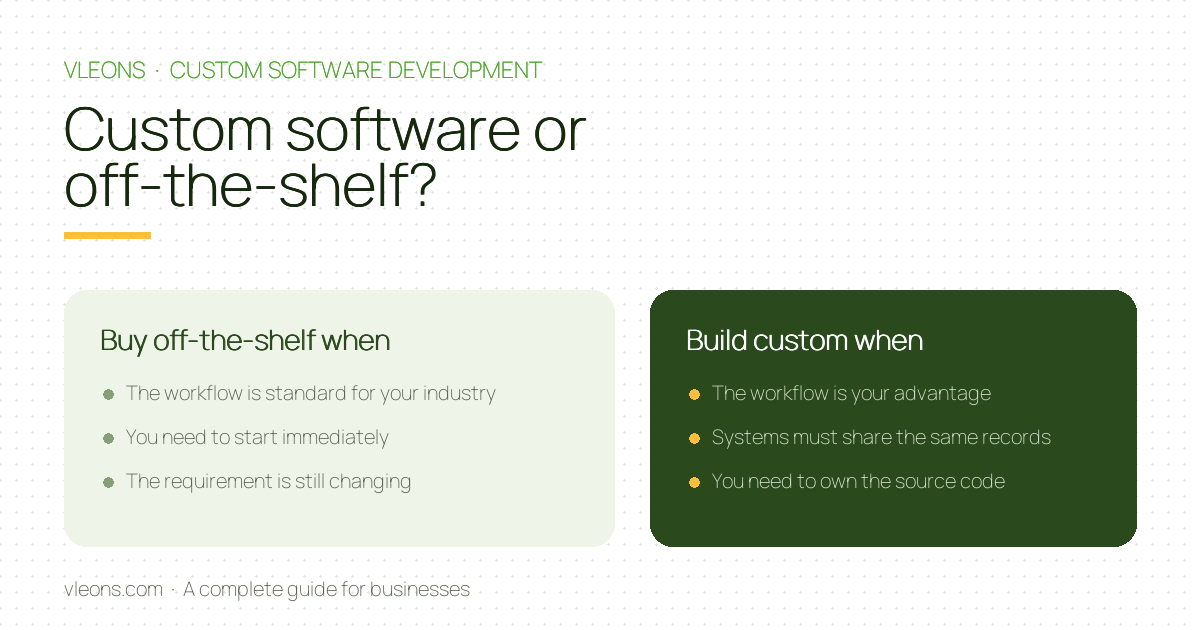
Off-the-shelf software wins on speed and cost at the start. Custom software wins on fit, ownership and the cost of the exceptions. The honest comparison looks like this:
| Situation | Better choice | Why |
|---|---|---|
| Your workflow is standard for your industry | Off-the-shelf | Someone has already solved it, tested it on thousands of businesses and will maintain it for you. |
| Your workflow is the thing that makes you competitive | Custom | Bending a competitive process to fit a product usually removes the advantage. |
| You need the fastest possible start | Off-the-shelf | A subscription starts today. A build starts after discovery. |
| You need to own the source code | Custom | Ownership is a contractual outcome of a build, not of a licence. |
| Several systems must share the same records | Usually custom | Integration work tends to cost more than the subscriptions it joins together. |
| Your team is already paying for workarounds | Custom | Exports, re-keying and spreadsheets are a recurring cost most companies never add up. |
| The requirement is uncertain and may change next quarter | Off-the-shelf first | Buy time to learn the requirement before paying to encode it. |
Most businesses end up with both. A typical setup is an off-the-shelf accounting package, an off-the-shelf email platform, and one custom system in the middle that holds the part of the business nobody else does the same way.
When to build custom software
Build when at least two of these are true, and the problem has been stable for long enough to be worth encoding:
- The workaround has a payroll cost. Someone spends hours every week moving data between tools, chasing approvals or rebuilding the same report.
- The data lives in several places and disagrees with itself. Two systems hold the same customer and neither is authoritative.
- You cannot buy the rule. Your pricing, approval chain, production process or compliance requirement does not exist as an option in any product you can subscribe to.
- Growth is blocked by the software. Adding a branch, a product line or a user type means another spreadsheet instead of another record.
- You need the asset. Investors, acquirers or regulators need the system and its data to belong to the company.
Do not build when the requirement is still being discovered, when the only driver is dislike of a subscription price, or when nobody internally owns the project. Software built without an internal owner tends to be delivered correctly and then used by nobody.
Custom software development benefits
Advantages of custom software
- The process stays yours. You change the software to fit the business rather than the reverse.
- One source of truth. Records live once, which is what makes reporting trustworthy.
- Integration is designed in. APIs to your accounting, logistics, payment or messaging providers are part of the build, not a plugin lottery.
- Access control that matches your org chart. Roles, approvals and audit trails are built around who actually does what.
- Scalable software solutions. A data model designed for your growth path takes new modules without a rewrite.
- Ownership. Source code, data and deployment are yours, which also means you can change supplier without changing software.
- No per-seat tax on growth. Adding staff does not multiply a monthly licence.
Disadvantages of custom software
Anyone who sells you custom software without this section is selling, not advising.
- It starts slower. Discovery, design and build take time a subscription does not.
- The cost is visible. It arrives as a project cost rather than hidden inside an operating budget.
- You inherit responsibility. Hosting, backups, updates and security are now decisions your business makes.
- It needs an owner. Requirements come from your team; a vendor cannot invent them for you.
- Bad scope is expensive. A vague brief turns into change requests, and change requests turn into timelines.
- Maintenance is permanent. Software that is used changes. Budget for it or watch it decay.
The custom software development process
The custom software development lifecycle below is the one we run. The labels differ between companies; the sequence rarely does.
1. Discovery and process mapping
We map how the work happens now — who touches each record, where the exceptions are, which systems hold which data — and write the scope down with a fixed price before development starts. Most failed projects we are asked to rescue failed here, not in the code.
2. Architecture and data model
The data model decides what the software can become. Getting entities, relationships and permissions right at this stage is what keeps module five from requiring a rewrite of module one.
3. Interface design
Screens are designed and agreed before production code is written. For internal systems, the measure is not beauty; it is how fast a trained user can complete the task they do forty times a day.
4. Development
Built in stages you can see and test, with security, performance and testing handled as part of the work rather than a phase at the end.
5. Deployment and handover
Deployment to your hosting, data migration where needed, documentation, and handover of source and accounts. This is the point where ownership becomes real rather than contractual.
6. Custom software maintenance
Fixes, dependency and security updates, small improvements, and the occasional new module. Treat it as a standing line in the budget, in the range of a modest percentage of the build cost each year, rather than an emergency.
If you want the same sequence in plain stages — Discovery, Design, Development, Launch — it is on our custom software development services page with what each stage delivers.
How much does custom software development cost?
There is no honest list price. Custom software development cost is driven by scope, not by category: the number of distinct user roles, the number of integrations, how much existing data has to be migrated, and how strict the security and audit requirements are. A single-purpose internal tool and a multi-module business platform are both “custom software” and can differ by an order of magnitude.
What you should expect from a credible custom software development company is a written, fixed-price proposal for a defined scope before work starts — not an hourly estimate that discovers its own ceiling. Ours are structured that way, with 50% to begin and 50% before deployment, and hosting, domains and third-party licences paid separately in your name.
The variables that actually move the number:
| Cost driver | Why it moves the price |
|---|---|
| Number of user roles | Every role adds screens, permissions and test cases. |
| Integrations | Third-party APIs bring authentication, error handling, rate limits and their own release cycles. |
| Data migration | Cleaning and mapping legacy data is often larger than the feature that consumes it. |
| Reporting depth | A list view is cheap. A report builder that users can configure is a feature in its own right. |
| Compliance and audit | Audit trails, retention rules and access reviews change the data model, not just the UI. |
| Design scope | An internal tool needs usability. A customer-facing product needs a designed experience. |
| Deadline | Compressed timelines cost more and usually buy less. |
Three ways to reduce the number without damaging the result: cut the first release to the workflow that pays for itself, reuse proven components instead of commissioning novelty, and bring clean data to the migration.
How long does custom software development take?
Timelines follow scope. A focused internal tool with one or two roles and no migration is a matter of weeks; a multi-module platform with integrations, migration and several user types runs in months, delivered in stages rather than one release. Anyone quoting a duration before seeing your processes is quoting an average, not your project.
What you can insist on is a schedule attached to the proposal, with what each stage delivers and what is explicitly excluded. Two things reliably stretch a timeline: requirements that arrive after design is signed off, and a third-party system whose API behaves differently from its documentation.
What we have learned building these systems
First-party notes from live projects, because generic advice is cheap.
Configuration beats code for anything that repeats. On Sublime Care Cloud, an ERP platform, module definitions are held as metadata: the same JSON field definitions generate the data entry forms and the list views, and modules register themselves from the API controllers. The effect is that a new area of the business is configuration rather than another hand-built screen to maintain. If you expect to add modules for years, decide early which parts of your system are data and which are code.
The expensive problem is usually content and data, not features. On Zuriyat Foods, a WooCommerce store, the costly issue was the same product information repeated across posts and product pages with no authoritative version, and SEO settings living in the database where a plugin change could erase them. The fix was architectural: one source of truth for product facts, and the SEO configuration applied from code so it survives theme and plugin updates. Ask any vendor where your content and configuration will live after the build.
Decide where each workflow lives before you build. On Sublime Groceria, the same list product runs as an Android app and a browser app. Splitting that cleanly — which part is shared, which is platform-specific — is a decision made at architecture time, and it is expensive to revisit later.
Business process automation software earns its keep in the boring places. The highest return we see is rarely a dashboard. It is the approval that no longer needs an email, the stock number that no longer needs re-keying, and the report that no longer needs a spreadsheet.
Software modernization: when the answer is a rebuild
Not every custom software project starts from nothing. A large share of the work is software modernization: a system that still runs the business but cannot be extended, has no upgrade path, or depends on a framework version that no longer receives security updates.
Modernise in place when the data model is sound and only the interface or platform is dated. Rebuild when the data model itself blocks what the business now does — and when you rebuild, migrate the data first and design the new model around today’s process rather than reproducing the old system’s compromises.
How to choose a custom software development company
Judge the proposal, not the pitch. Before signing, you should be able to answer all of these:
- Can they show live systems they built? Working URLs and a description of what they were responsible for, not a gallery of logos.
- Is the scope written down with a fixed price? Including what is excluded. Vagueness at this stage becomes change requests later.
- Who owns the source code, data and accounts? It should say so in writing, and hosting should be in your name.
- Who will you actually talk to? Ask whether the people in the meeting are the people writing the code.
- What happens after launch? Support terms, response expectations, and what handover documentation you receive.
- Why this technology? A good answer references your requirements. A weak one references the only stack they know.
- How is progress visible? Staged delivery you can test beats a single reveal at the end.
- Can they say no? A partner who tells you which parts of your list are not worth building is more valuable than one who prices everything.
Two warning signs worth naming: a quote produced without any discovery, and a refusal to hand over source code or hosting access.
Frequently asked questions
What is the difference between custom software and off-the-shelf software?
Off-the-shelf software is built for a market and licensed to you; custom software is built for your processes and owned by you. The practical test is whether your competitive advantage fits inside the product’s assumptions.
How much does custom software development cost?
It depends on roles, integrations, data migration, reporting depth and compliance requirements. Expect a written fixed-price proposal for a defined scope rather than a list price, and treat any number quoted before discovery as a guess.
How long does custom software development take?
A focused internal tool takes weeks; a multi-module platform with integrations and migration takes months, delivered in stages. The proposal should carry a schedule with stage deliverables.
Who owns the software when the project is finished?
You should. In our projects the client receives the complete source, files and accounts, with hosting, domains and premium licences in their own name and paid separately.
What does custom software maintenance involve?
Security and dependency updates, fixes, small improvements and occasional new modules. Budget for it annually; software that is actively used always changes.
Which technologies do you use for custom business software?
ASP.NET Core and C# for the API, Angular for admin interfaces, SQL Server for data, Flutter where a mobile app is needed, and WordPress or WooCommerce where the requirement is genuinely a website or store. The choice follows the project, not the other way round.
Can custom software integrate with the systems we already use?
Yes, and in most projects that is the main point. Integration work is scoped explicitly because third-party APIs carry their own authentication, limits and failure modes — see API and system integration.
Planning a system your current tools cannot carry? VLEONS designs and builds custom business software around real operational requirements — written scope and fixed price before development, full ownership on handover.
Explore custom software development →
Related reading: ERP and CRM systems, SaaS product development, and the case studies behind the examples above.